
Deleting Memories, Designing Futures: Lessons from Eternal Sunshine of the Spotless Mind
- Mariana Lema

- Jul 20
- 3 min read
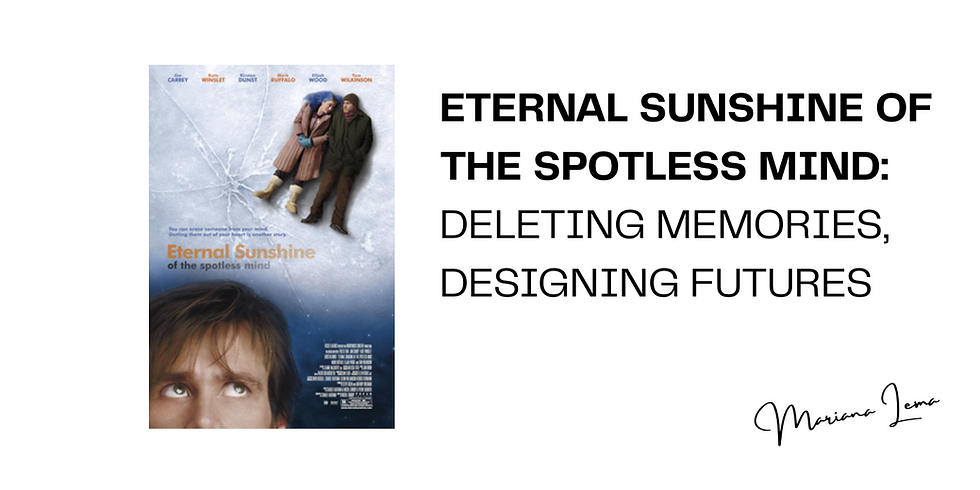
What would you erase if you could? Eternal Sunshine of the Spotless Mind opens with that impossible question and turns it into a haunting love story. Joel and Clementine undergo a procedure to wipe each other from memory, and in the process we witness what it really means to design with erasure.
The film lingers with me because it does not only explore memory. It explores design choices. Every act of creativity, every technological system, every interface decision carries a quiet question: what do we highlight, and what do we choose to forget?
The Architecture of Memory
Visually, the film pulls us through collapsing landscapes, fading faces, and shifting rooms. Memories fall apart like sets being dismantled, until Joel is left in empty spaces where meaning used to live.
This collapsing architecture feels eerily familiar when I think about the way technology shapes memory today. Social media archives our lives, but also curates them, deciding which moments resurface as “On This Day.” Search engines deliver knowledge instantly, but bury other truths deeper. The design of these systems is not neutral. It is an architecture that defines how and what we remember.
Eternal Sunshine reminds me that memory is always constructed. For creatives and technologists, the question becomes: what architecture are we building for the future, and whose memories are we erasing in the process?
Erasure as Design Choice
The company in the film treats forgetting as a service, packaging memory deletion as liberation. But what strikes me is how similar this is to everyday design choices we already make. A minimalist interface erases clutter. A content filter erases certain images. A campaign chooses one story and leaves another untold.
Design is not only about creation. It is about deletion. And deletion is never innocent. Every choice about what not to show is as powerful as the choice about what to display.
For me, this is the uncomfortable brilliance of the film. It reveals how easily design can cross from simplifying into erasing, from clarifying into distorting.
Creativity Lives in Imperfection
Joel realizes, too late, that he does not want to lose Clementine. Even the painful memories carry meaning. The erasure strips away not only the hurt, but the beauty that was intertwined with it.
This lesson resonates deeply with creativity. We are often tempted to polish ideas until they are flawless, to edit out the rough edges. But sometimes the imperfections are what make work memorable. A design that feels too smooth risks feeling empty. A campaign that avoids discomfort risks saying nothing at all.
Eternal Sunshine suggests that creativity is not about spotless perfection. It is about embracing the messy, contradictory truths that make something real.
Technology and the Ethics of Forgetting
Looking at the film now, I cannot help but think about our own technological tools of forgetting. Algorithms decide which posts we see and which ones fade. Entire communities can be erased when their stories are not documented. AI systems trained on biased data can “forget” people by excluding them.
As a Strategic Creative Technologist, this raises a responsibility: how do we design systems that remember ethically? What do we choose to preserve, and what do we allow to disappear? Forgetting can be a mercy. It can also be an injustice.
Designing for Futures, Not Spotlessness
The final irony of the film is that even after erasing each other, Joel and Clementine are drawn together again. Memory deletion does not fix the future. It only erases the chance to learn from the past.
Creativity is not about erasing what hurts, it is about finding ways to carry complexity forward.


Comments